
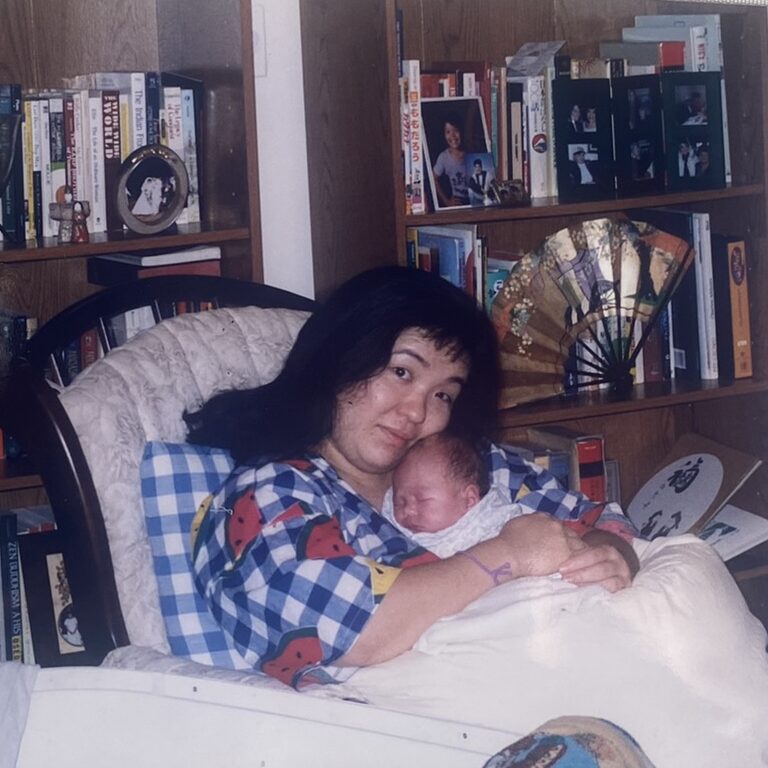
The people I’m caring for is my ikigai–to get up and have a goal, to make sure they reach their goal. …but it’s not just for them, it’s also that you can be satisfied that you did your very best job. If you did the very best you know you could do, then when you look back, you don’t regret it.
Naomi Kumano, 2024
Naomi’s Story
Direct link to StoryMap: Naomi’s Story
Reflection
Interview Analysis
My interview with my mother, Naomi, begins with bread. Her husband, Mark, delivers her a bowl of soup and a slice of his freshly baked bread. Naomi looks over the bread and asks whether he’s put sesame seeds on it. He says yes, and she nods, “Good.”
Naomi’s first job is as a travel guide at the Hilton Hotel in Honolulu. “I was in High School, and I help Japanese tourists plan their trips.” While this is her first official job, Naomi began work when she was in twelve years old, taking care of her younger brother, Shogo.
Naomi explains, “Because Obaachan was working and Ojiichan was working, I was responsible for taking care of Uncle Shogo while they were at work, and so that usually meant taking him to preschool in the morning and picking him up after school, and then going home, and maybe we would have a snack. And if Obaachan was working at night, she would leave instructions for how to make dinner, and she would mostly make it then she would have a few things left that needed to be done. And so that is how I learned to cook. I got my 10,000 hours of practice cooking meals for my younger brother.”
As described in the previous chapter, Tokiko (Obaachan) was almost always working, and due to her many shifts, a fair share of parenting-labor fell onto Naomi.
Parentification is when a child is forced to take on the role of a supportive adult within their family, and is a process by which children become skilled at suppressing emotions in service of others.
As a child, Naomi’s caretaking led to early involvement with typicaly adult endeavors. She recounts a story of a parent-teacher conference, “Oh, it was so embarrassing. Shogo would always be running around and talking during class. The teacher, this young girl, she was very new. She didn’t know what she was doing, and she called Mom in to talk to her about Shogo. And I had to go and translate, of course.”
Despite responsibilities at home, Naomi explains that on the weekends, Marichan would offer an outlet of childhood.
“Marichan would usually come and pick me up, and I could go spend myweekends with Marichan and Auntie Lynn and Auntie Violet. And then, by then, they were probably in high schools, so if they were home, we would do things together, and if they were busy going out doing other high school things, I would spend time with Marichan, and we would go to eat dinner at different restaurants and spend time together. And she would tell me stories, and she would take, we would go shopping and just bura bura around Ala Moana or Waikiki. And we would go out to eat at some famous local restaurants. And sometimes she would take the take me to the very, very fancy restaurant and let me order anything on the menu. So that’s where I learned to enjoy the fancy food, too.”
It is the experiences that Naomi was given by Marichan that inspire her as a caregiver. During her career as a teacher, Naomi is proud to say that she makes sure her students feel cared for in the classroom. “I have students come up to me, ones who weren’t doing too well, too, and they tell me, your class was my favorite part of school. And, you know, it’s because I make it special. I did activities, and I’d listen to them.”
As a mother, this manifested in Naomi’s determination to become a stay at home mother to nurture her children’s education. She explained that, as a teacher, all the most confident children had parents who were involved with their children. “And so I thought, when my kids, if I have kids, when they are growing up, I want to make sure I’m there.”
Marichan’s experiences no doubt inspired Naomi’s parenting, and in her description of her ikigai, Naomi explains, “The people I’m caring for is my ikigai. To get up and have a goal, to make sure they reach their goal. Making sure that they learn something every day. If it was raising kids, that they were healthy, that they understood right from wrong, knew how to do things, so that when they’d grow up, they would be independent and not totally clueless. And taking care of Ojiichan and Obaachan. My goal is that Ojiichan stays healthy and Obaachan stays healthy and that they can enjoy every day in the safest way possible and throw in some experiences so that they have something to look forward to so that when we look back we can say “that was a nice time, I’m glad we did that”.
However, as Marichan’s experiences manifest themselves in her ikigai, so too does Tokiko’s determination. Naomi goes on, “But it’s not just for them, it’s also that you can be satisfied that you did your very best job. If you did the very best you know you could do, then when you look back, you don’t regret it. Even if it doesn’t turn out great, at least you know you did the very best you could do and you couldn’t have done anymore than that. So you can be satisfied. But if you did your best, you can say “I tried”.
To do one’s best to ensure no regrets is an hierloom passed from generation to generation. Ella’s discussion of work invokes the same dedication.