
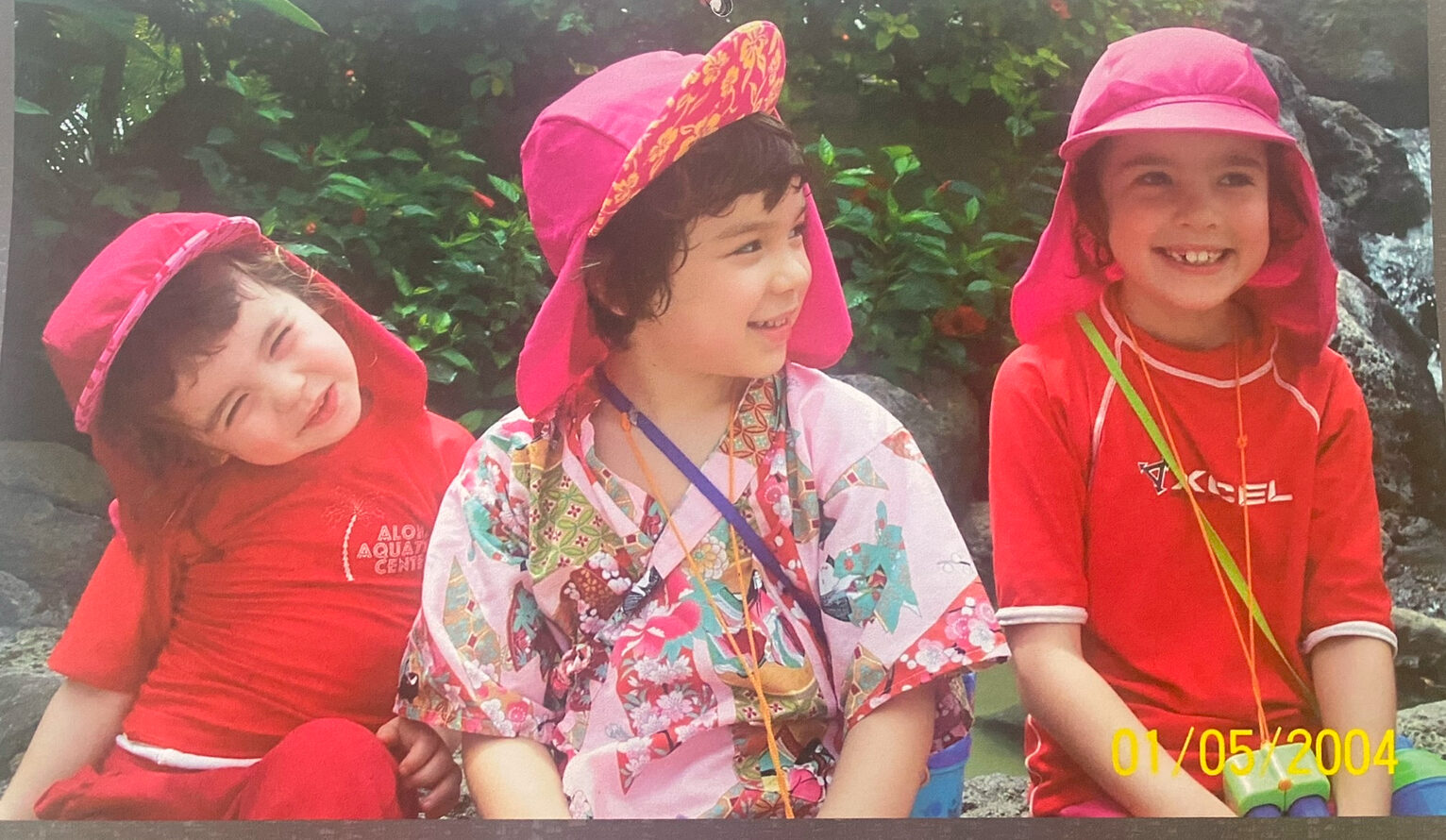
To be young and to know your ikigai…that would be lucky.
Mei Kumano-Maloney
Kumano-Maloney Sisters’ Story
Direct link to story: The Kumano-Maloney Sisters’ Story
Reflection
Every Saturday from 2006 to 2016, my sisters and I would visit Robert DePasquale. Mr. DePasquale—“Mr. D,” as we called him—is a former member of the Philadelphia Orchestra and the New York Philharmonic, and a ninety-something-year-old man with a razor-sharp sense of humor.
On the hour-long drive to Ambler, Pennsylvania, we would argue over who would be taught first. None of us ever practiced enough, so the time between arriving in Ambler and starting our lesson became a frantic period to improve at least a few measures of music.
At some point during the drive, our mother would inevitably launch into a twenty-minute lecture. Daughter by daughter, she’d list how each of us could have practiced more diligently over the past week. Then she’d segue into a speech on the importance of music, dedication, and her own sacrifices. “Your father doesn’t appreciate how hard I work to have you play violin and viola,” she’d say. “But Mr. D is one of the greatest teachers anyone could have. He played under Eugene Ormandy, under Bernstein. Do you think he got to be so great without practicing? By rushing for an hour before lessons?”
To be certain, Mr. D is an icon. That, we knew by heart.
- Mr. D is taught music by his father, along with all his brothers. His father loves the violin, and wants to have his very own string quartet. So each DePasquale brother is assigned violin, viola, cello, and bass.
- Mr. D’s father would strike his elbow everytime he had a ‘crooked bow’. We know this because Mr D taps our elbows with his bow each time it falters.
- Mr. D played for the Emperor of Japan back when he was with the New York Philharmonic, and played poker with group of geishas.
- He was buddies with ‘Lenny’ Bernstein, and he hated the biopic. “Yes, he was bisexual, but my god, who cares? And the nose? Bradley Cooper oughtta be ashamed.”
- Mr. D taught us for free after our Dad lost his job; my Mom would write him checks, and he would never cash them in.
- Mr. DePasquale is very Italian.
The list continues on and on, but point #5 is the one I can never forget. For free? Our whole lives, the goal of financial stability floated around our heads like an incredibly depressing cartoon lightning bulb. Every endeavor undertaken was a privilege. Of that, Mama made sure we never forgot.
“I always wanted to play the piano, and I used to play on my neighbor’s–I could even play backwards. But then, he moved, and we couldn’t afford our own. You three are lucky to play!”
And we were lucky. But deep down, we all harbored a complicated relationship with music. We loved Mr. D and the symphony, but the sting of not being prodigies lingered. Ella was the most talented, but none of us pursued music professionally.
For about four years, I would tell people I wanted to be a professional violist. “I want to go to Curtis,” I’d say. “I want to go to Juilliard.” I knew I was a mediocre violist and that neither of those dreams was feasible. But seeing the smile on Mom’s face made the pretense worthwhile.
Performing dedication to someone else’s dream is a skill anyone can master. Simply read the person, understand what they want, and complain accordingly: “I wish I had more time to practice!” “I wish we were playing Carmen instead of Candide!” “I wish I could play like Midori!”
When Mr. D dropped me as a student, the act came to an abrupt stop. He told me he couldn’t teach me the way I needed. What I heard was, “Emma, you don’t practice enough, and I’m done.”
Without the ritual of Mr. D’s lessons and with Ella and Mei choosing paths outside of music, my charade of musical ambition dissolved. Paradoxically, once I stopped pretending, I actually began to improve.
Ikigai is meant to give purpose to life. I once thought my ikigai was to be like my sisters. Then I thought it was to be a musician. Later, I was sure my ikigai was organizing birthday parties.
So, what brings meaning to life? What propels me forward?
As funny as it might sound, I think my ikigai is to know people. To read them like my grandmother does, and to bring some kind of joy.
To use up my best, I will keep going.
In our interview, Ella shared the importance of being thorough in her work. She told me, “I only really find it fulfilling when I do something to the best of my abilities. The best of my abilities are not perfect, but if I can do the best that I can, when I walk away, I can feel like I’ve done my job.”
She described the experience of working at the chef’s table, where diners watch her cook. When she doesn’t perform to her highest standards, she said, there’s a sense of shame or embarrassment. Everyone in the kitchen feels a collective pressure to give their best.
Ella explained, “Even though a lot of people may come in and view us as ‘the help’—which some have explicitly said—knowing that you are doing something so diligently, carefully, and passionately feels like a privilege. It feels like a gift.”
This idea of looking back and knowing you’ve tried your best is a thread that ties many of us together. When I reflect on my own work, I also want to know that I’ve tried my best—but I don’t believe my best needs to be “on” all the time.
From playing the viola, I’ve learned that I’ve never been, and will never be, the best. When I feel passionate about something, I’ll try my very best, but I see no reason to pour my all into work unless it gives something meaningful back. For me, it’s human connection that inspires my sense of ikigai. And for the women in my family, I think we all want to know that we’ve done our best and that those around us are better for it. Or, perhaps, it’s simpler, as Mei speculated about her possible ikigai: “I want to make money, eat good food, and spend time with my loved ones.”